> ## Documentation Index
> Fetch the complete documentation index at: https://help.ruddr.io/llms.txt
> Use this file to discover all available pages before exploring further.
# QuickBooks Desktop Support
QuickBooks Desktop (or Enterprise) is the desktop-based predecessor to [QuickBooks Online](/integrations/quickbooks-online-integration-overview). To support workspaces that leverage the desktop version of QuickBooks, Ruddr provides the ability to export invoices in a format that is accepted by QuickBooks Desktop.
To quickly and easily create invoices in QuickBooks from Ruddr, invoices [can be exported from Ruddr](#generating-the-export-file) in the Intuit Interchange Format (.IIF). This IIF format is a tab-separated text file format that is proprietary to QuickBooks and allows for the import of financial transactions.
### Enabling QuickBooks Desktop Support
The QuickBooks Desktop export feature can be enabled from within the [Integrations](/workspace-administration/integrations) section of [Workspace Settings](/workspace-administration/managing-your-workspace). A member must have the Workspace Admin security role to access and enable this function.
From within the Integrations section, there will be a QuickBooks Desktop tile (Figure 1). Click **Install** to enable the QuickBooks Desktop export functionality.
 Upon clicking **Install**, you will be prompted (Figure 2) to configure settings for the integration. There are general settings and project settings.
#### General Settings
The first setting to provide is a **Discount Account**. Providing this account will ensure that exported Ruddr invoices with discounts will be listed with the appropriate discount account when imported into QuickBooks Desktop. The discount account must be spelled exactly as the account in QuickBooks is spelled.
Upon clicking **Install**, you will be prompted (Figure 2) to configure settings for the integration. There are general settings and project settings.
#### General Settings
The first setting to provide is a **Discount Account**. Providing this account will ensure that exported Ruddr invoices with discounts will be listed with the appropriate discount account when imported into QuickBooks Desktop. The discount account must be spelled exactly as the account in QuickBooks is spelled.
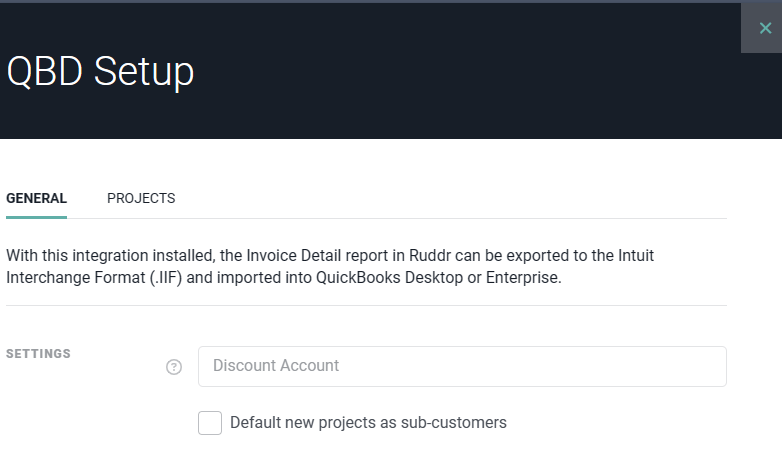 This **Discount Account** field is optional and thus a value does not have to be provided to activate the QuickBooks Desktop support in Ruddr. However, if the Discount Account is not properly configured, any discounts exported via the .IIF file will not be properly coded in QuickBooks Desktop.
The second setting, **Default new projects as sub-customers**, controls whether or not new projects in the workspace are treated as sub-customers when invoices for those projects are exported.
In QuickBooks, if you have created sub-customers to denote projects, you can generate project invoices in Ruddr and import them for sub-customers in QuickBooks. By specifying a project as a sub-customer, when the IIF file is generated, Ruddr will append the project name to the client name for purposes of importing into QuickBooks Desktop. The format will be: **Client Name:Project Name**, where the client and project names are separated by a colon.
#### Project Settings
On the **Projects** tab (Figure 3) of the QBD (QuickBooks Desktop) Setup drawer, you can manage which projects in the workspace are to be treated as sub-customers.
This **Discount Account** field is optional and thus a value does not have to be provided to activate the QuickBooks Desktop support in Ruddr. However, if the Discount Account is not properly configured, any discounts exported via the .IIF file will not be properly coded in QuickBooks Desktop.
The second setting, **Default new projects as sub-customers**, controls whether or not new projects in the workspace are treated as sub-customers when invoices for those projects are exported.
In QuickBooks, if you have created sub-customers to denote projects, you can generate project invoices in Ruddr and import them for sub-customers in QuickBooks. By specifying a project as a sub-customer, when the IIF file is generated, Ruddr will append the project name to the client name for purposes of importing into QuickBooks Desktop. The format will be: **Client Name:Project Name**, where the client and project names are separated by a colon.
#### Project Settings
On the **Projects** tab (Figure 3) of the QBD (QuickBooks Desktop) Setup drawer, you can manage which projects in the workspace are to be treated as sub-customers.
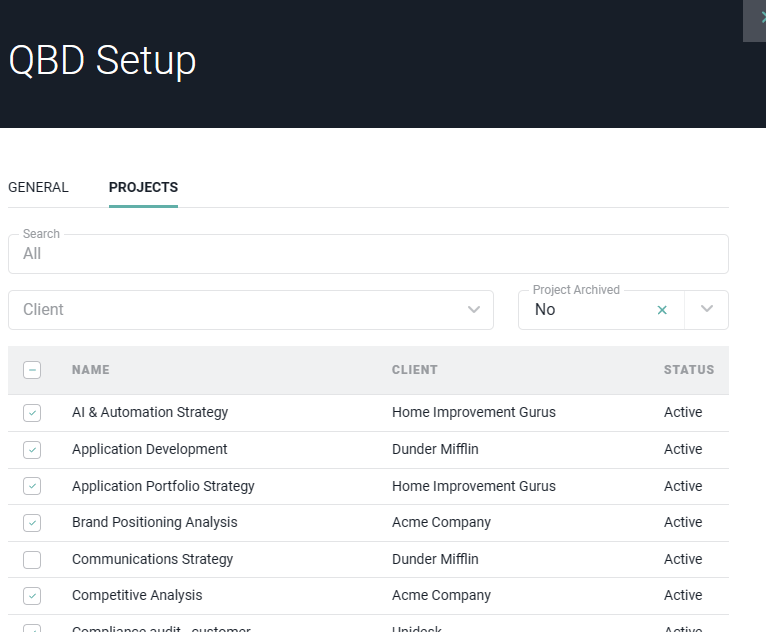 Simply check the box listed next to each project name in the drawer. The list of projects can be filtered by Client. You can also filter projects based on whether or not they are archived. Finally, you can use the **Search** textbox at the top of the drawer to find specific projects based on their Project Name.
**NOTE**: invoices that have been created for multiple projects (on a single invoice) will not be exported with sub-customers appended to the client name.
Once the settings have been configured, click on the **Save & Activate** button at the bottom of the drawer to save the settings and to activate the support for QuickBooks Desktop exports.
### Generating the IIF File
Once the QuickBooks Desktop support has been enabled, you will be able to export the Invoice Detail report, which can be found in the [Financial](/reports/accounting-reports) section of Ruddr reports.
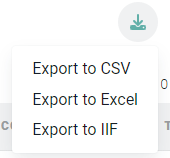
Once the report has been run and any report filters have been applied to include the invoices you wish to export, you can choose the **Export to IIF** option (Figure 4). This option is only available if the QuickBooks Desktop integration has been installed.
Simply check the box listed next to each project name in the drawer. The list of projects can be filtered by Client. You can also filter projects based on whether or not they are archived. Finally, you can use the **Search** textbox at the top of the drawer to find specific projects based on their Project Name.
**NOTE**: invoices that have been created for multiple projects (on a single invoice) will not be exported with sub-customers appended to the client name.
Once the settings have been configured, click on the **Save & Activate** button at the bottom of the drawer to save the settings and to activate the support for QuickBooks Desktop exports.
### Generating the IIF File
Once the QuickBooks Desktop support has been enabled, you will be able to export the Invoice Detail report, which can be found in the [Financial](/reports/accounting-reports) section of Ruddr reports.
Once the report has been run and any report filters have been applied to include the invoices you wish to export, you can choose the **Export to IIF** option (Figure 4). This option is only available if the QuickBooks Desktop integration has been installed.
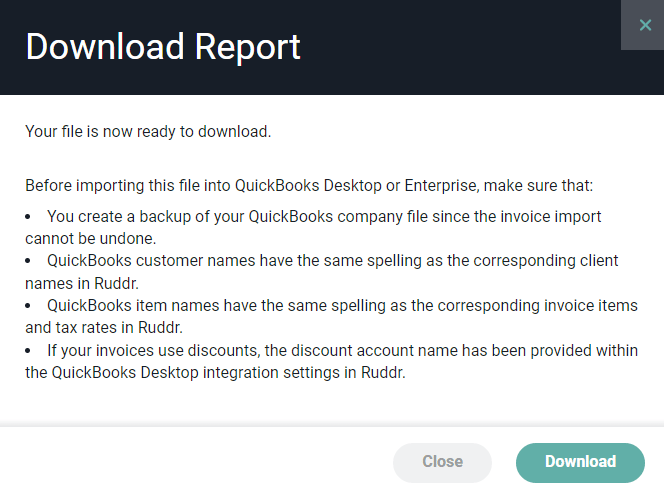
 Prior to downloading the IIF file, Ruddr will prompt the user with a list of recommendations (Figure 5) to consider prior to importing the file into your QuickBooks Desktop environment.
Before you import the IIF into QuickBooks Desktop, it is recommended that you take the following actions:
* **Create a backup of your QuickBooks company file.** The invoice import cannot be undone - you will want to have a copy of your company file should you need to revert to a prior instance.
* **Ensure that your QuickBooks customer names have the same spelling as the corresponding client names in Ruddr.** This must match in spelling and case (upper / lower) down to each character.
* **Ensure that QuickBooks item names must have the same spelling as the corresponding invoice items and tax rates in Ruddr.** As with customers / clients, these must match in spelling and case (upper / lower) down to each character.
* **If your invoices will have discounts applied, the Discount Account name that was provided in the integration setup (Figure 2) should match the name of the corresponding account in QuickBooks.**
Prior to downloading the IIF file, Ruddr will prompt the user with a list of recommendations (Figure 5) to consider prior to importing the file into your QuickBooks Desktop environment.
Before you import the IIF into QuickBooks Desktop, it is recommended that you take the following actions:
* **Create a backup of your QuickBooks company file.** The invoice import cannot be undone - you will want to have a copy of your company file should you need to revert to a prior instance.
* **Ensure that your QuickBooks customer names have the same spelling as the corresponding client names in Ruddr.** This must match in spelling and case (upper / lower) down to each character.
* **Ensure that QuickBooks item names must have the same spelling as the corresponding invoice items and tax rates in Ruddr.** As with customers / clients, these must match in spelling and case (upper / lower) down to each character.
* **If your invoices will have discounts applied, the Discount Account name that was provided in the integration setup (Figure 2) should match the name of the corresponding account in QuickBooks.**