> ## Documentation Index
> Fetch the complete documentation index at: https://help.ruddr.io/llms.txt
> Use this file to discover all available pages before exploring further.
# Connect ChatGPT and Codex to Ruddr
> Add Ruddr to ChatGPT, to a ChatGPT Business or Enterprise workspace, or to the Codex CLI, desktop app, and IDE extension.
**NOTE:** The Ruddr Assistant [feature](/workspace-administration/features) must be enabled in workspace settings in order for this to be available in your workspace.
OpenAI's tools reach outside services through MCP servers. Each one asks for the Ruddr server address:
```text theme={null}
https://www.ruddr.io/api/mcp
```
You are never asked for a password, an API key, or a token. Whichever tool you use, Ruddr asks you to sign in and approve the connection at the end — see [Connecting an Application](/integrations/ai-connectors-overview#connecting-an-application).
OpenAI's settings and menu labels change from time to time, so treat OpenAI's own [MCP documentation](https://learn.chatgpt.com/docs/extend/mcp) as the authority on the screens themselves — what follows is what to enter when you get there.
In ChatGPT itself, Ruddr is added from one of two places depending on your plan. Both open the same form, and you enter the same values in each.
#### Adding Ruddr to Your Own ChatGPT Account
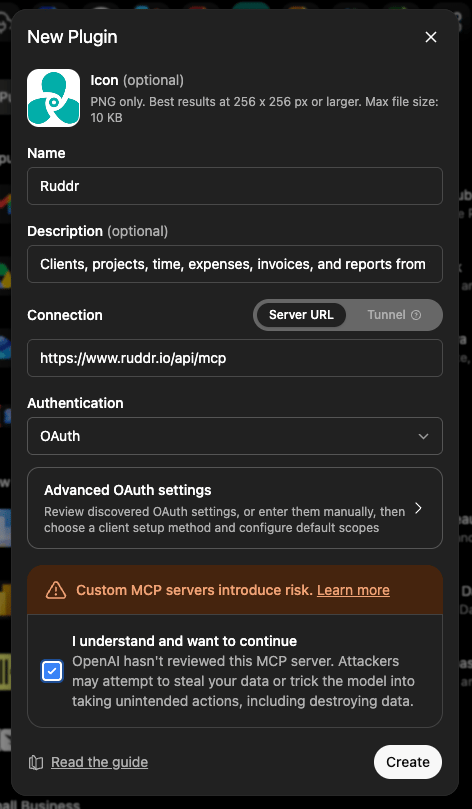
On an individual account, Ruddr is added as a custom plugin. This requires **developer mode**, which you turn on in **Settings > Security and login**. Then go to **Settings > Plugins**, click **+**, and fill in the **New Plugin** dialog (Figure 1). OpenAI's [Connect and test your plugin](https://developers.openai.com/plugins/deploy/connect-chatgpt) covers these screens. On an individual account Ruddr connects for reading only; creating and updating records requires a Business, Enterprise, or Edu workspace.
 #### Adding Ruddr to a ChatGPT Business or Enterprise Workspace
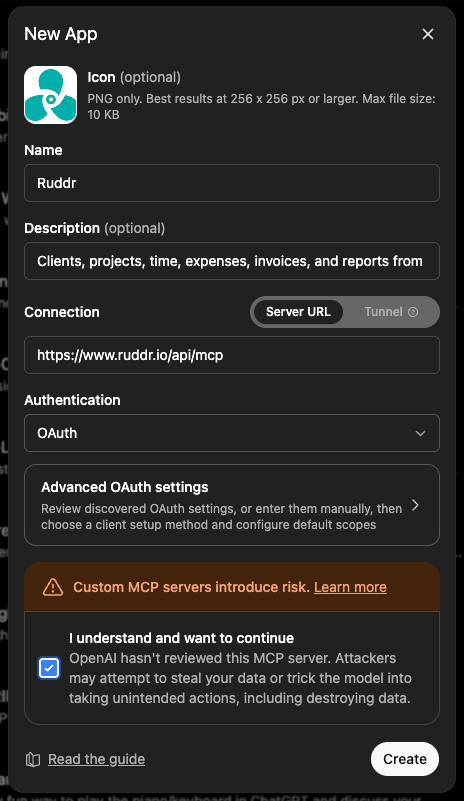
In a Business, Enterprise, or Edu workspace, Ruddr is added as a custom app by an admin or owner, not by individual members. This also requires **developer mode**, which an admin turns on in **Workspace settings > Permissions & roles**, under **Connected Data**. The admin then goes to **Workspace settings > Apps**, clicks **+ Create**, and fills in the **New App** dialog (Figure 2), which asks for the same values as the plugin form above.
#### Adding Ruddr to a ChatGPT Business or Enterprise Workspace
In a Business, Enterprise, or Edu workspace, Ruddr is added as a custom app by an admin or owner, not by individual members. This also requires **developer mode**, which an admin turns on in **Workspace settings > Permissions & roles**, under **Connected Data**. The admin then goes to **Workspace settings > Apps**, clicks **+ Create**, and fills in the **New App** dialog (Figure 2), which asks for the same values as the plugin form above.
 This is a beta feature in ChatGPT and its screens change as OpenAI iterates, so follow their current instructions in [Developer mode and MCP apps in ChatGPT](https://help.openai.com/en/articles/12584461-developer-mode-and-mcp-apps-in-chatgpt) for the steps themselves. Three things are worth knowing before you start:
* **Which plans.** Full MCP support, including the ability to create and update records, is available on ChatGPT Business, Enterprise, and Edu, on the web only — not on mobile.
* **What publishing does and does not do.** After the app is created it appears as a draft, and an admin publishes it to the workspace from **Workspace settings > Apps > Drafts**. Published apps appear in members' **Apps** settings labeled **Custom**. Publishing gives nobody access to Ruddr data. Each member still connects Ruddr, signs in, and approves it individually, and then sees only what their own [security role](/workspace-administration/security-roles) allows.
* **Updates are not automatic.** ChatGPT freezes the list of Ruddr tools at the moment you publish. When Ruddr adds new capabilities, an admin has to refresh the app's actions in workspace settings before members can use them. Ruddr reorganized its tools in September 2026, so an app published before then should have its actions refreshed — see [How a Connected App Reaches Your Data](/integrations/ai-connectors-overview#how-a-connected-app-reaches-your-data). Until an admin does, the app keeps working as it did.
#### What to Enter
| Field | What to enter |
| --------------------------- | -------------------------------------------------------------------------------------------------------------------------------------------------------------------------------------------------------------------------------------------------------------------------------------------------------------------------- |
| **Icon** | Optional. [Download the Ruddr icon](/images/ai-connectors-setup-icon.png) and upload it. ChatGPT accepts PNG files up to 10 KB and suggests 256x256 or larger; the Ruddr icon is within both. |
| **Name** | `Ruddr` |
| **Description** | Optional. Something like `Clients, projects, time, expenses, invoices, and reports from your Ruddr workspace`. |
| **Connection** | Choose **Server URL** rather than **Tunnel**, and enter the Ruddr server address above. |
| **Authentication** | **OAuth**. |
| **Advanced OAuth settings** | Leave these alone. Once the server address is in they read *Review discovered OAuth settings, or enter them manually, then choose a client setup method and configure default scopes* — but Ruddr publishes its own sign-in settings for ChatGPT to discover, so there is no client ID, secret, or scope for you to enter. |
Tick **I understand and want to continue**, then click **Create**. When you connect, ChatGPT sends you to Ruddr to sign in and approve the connection and then returns you to ChatGPT. You are never asked for a password, an API key, or a token — see [Connecting an Application](/integrations/ai-connectors-overview#connecting-an-application) for what that approval screen is asking.
#### About the Risk Warning
Both forms show the warning *Custom MCP servers introduce risk*, along with a note that OpenAI has not reviewed the server. This is OpenAI's standard notice for any MCP server it has not reviewed itself, not a judgment about Ruddr, and it appears no matter which server you add.
The Ruddr server acts as you. It returns only what your own [security role](/workspace-administration/security-roles) allows, so it cannot expose anything you could not already open in Ruddr. ChatGPT identifies itself to Ruddr using OAuth rather than a shared password or key, you approve the connection in Ruddr yourself, and you can revoke it whenever you like from your [Connected Apps](/getting-started/user-profile#connected-apps) page.
#### Codex CLI
Add Ruddr and then sign in, from a terminal:
```bash theme={null}
codex mcp add ruddr --url https://www.ruddr.io/api/mcp
```
```bash theme={null}
codex mcp login ruddr
```
The login command sends you to Ruddr to approve the connection. If you are working over SSH or on a machine with no browser, Codex may show you a short code instead — enter it at [**www.ruddr.io/device**](http://www.ruddr.io/device), as described in [Connecting a Device or Terminal](/integrations/ai-connectors-overview#connecting-a-device-or-terminal).
To confirm the connection, run `codex mcp list`. To remove it, run `codex mcp remove ruddr`.
#### Codex Desktop App and IDE Extension
In the desktop app, open **Settings** and select **MCP servers**. In the IDE extension, open the gear menu and select **MCP servers**. From there the steps are the same:
1. Select **Add server**.
2. Enter `Ruddr` as the name, choose **Streamable HTTP**, and enter the Ruddr server address as the URL.
3. Save the server, then select **Restart** — or **Restart extension** in the IDE.
4. Ruddr appears in the server list marked as needing authentication. Click **Authenticate** and approve the connection in Ruddr.
#### What a Connected Application Can See
A connected application acts as you. It can only read and change what your [security role](/workspace-administration/security-roles) already allows, so it can never reach data you could not open yourself in Ruddr. Anything it records is attributed to you, with the application shown as the source in the entry's history.
To review or revoke a connection, use the [Connected Apps](/getting-started/user-profile#connected-apps) page in your Ruddr profile.
This is a beta feature in ChatGPT and its screens change as OpenAI iterates, so follow their current instructions in [Developer mode and MCP apps in ChatGPT](https://help.openai.com/en/articles/12584461-developer-mode-and-mcp-apps-in-chatgpt) for the steps themselves. Three things are worth knowing before you start:
* **Which plans.** Full MCP support, including the ability to create and update records, is available on ChatGPT Business, Enterprise, and Edu, on the web only — not on mobile.
* **What publishing does and does not do.** After the app is created it appears as a draft, and an admin publishes it to the workspace from **Workspace settings > Apps > Drafts**. Published apps appear in members' **Apps** settings labeled **Custom**. Publishing gives nobody access to Ruddr data. Each member still connects Ruddr, signs in, and approves it individually, and then sees only what their own [security role](/workspace-administration/security-roles) allows.
* **Updates are not automatic.** ChatGPT freezes the list of Ruddr tools at the moment you publish. When Ruddr adds new capabilities, an admin has to refresh the app's actions in workspace settings before members can use them. Ruddr reorganized its tools in September 2026, so an app published before then should have its actions refreshed — see [How a Connected App Reaches Your Data](/integrations/ai-connectors-overview#how-a-connected-app-reaches-your-data). Until an admin does, the app keeps working as it did.
#### What to Enter
| Field | What to enter |
| --------------------------- | -------------------------------------------------------------------------------------------------------------------------------------------------------------------------------------------------------------------------------------------------------------------------------------------------------------------------- |
| **Icon** | Optional. [Download the Ruddr icon](/images/ai-connectors-setup-icon.png) and upload it. ChatGPT accepts PNG files up to 10 KB and suggests 256x256 or larger; the Ruddr icon is within both. |
| **Name** | `Ruddr` |
| **Description** | Optional. Something like `Clients, projects, time, expenses, invoices, and reports from your Ruddr workspace`. |
| **Connection** | Choose **Server URL** rather than **Tunnel**, and enter the Ruddr server address above. |
| **Authentication** | **OAuth**. |
| **Advanced OAuth settings** | Leave these alone. Once the server address is in they read *Review discovered OAuth settings, or enter them manually, then choose a client setup method and configure default scopes* — but Ruddr publishes its own sign-in settings for ChatGPT to discover, so there is no client ID, secret, or scope for you to enter. |
Tick **I understand and want to continue**, then click **Create**. When you connect, ChatGPT sends you to Ruddr to sign in and approve the connection and then returns you to ChatGPT. You are never asked for a password, an API key, or a token — see [Connecting an Application](/integrations/ai-connectors-overview#connecting-an-application) for what that approval screen is asking.
#### About the Risk Warning
Both forms show the warning *Custom MCP servers introduce risk*, along with a note that OpenAI has not reviewed the server. This is OpenAI's standard notice for any MCP server it has not reviewed itself, not a judgment about Ruddr, and it appears no matter which server you add.
The Ruddr server acts as you. It returns only what your own [security role](/workspace-administration/security-roles) allows, so it cannot expose anything you could not already open in Ruddr. ChatGPT identifies itself to Ruddr using OAuth rather than a shared password or key, you approve the connection in Ruddr yourself, and you can revoke it whenever you like from your [Connected Apps](/getting-started/user-profile#connected-apps) page.
#### Codex CLI
Add Ruddr and then sign in, from a terminal:
```bash theme={null}
codex mcp add ruddr --url https://www.ruddr.io/api/mcp
```
```bash theme={null}
codex mcp login ruddr
```
The login command sends you to Ruddr to approve the connection. If you are working over SSH or on a machine with no browser, Codex may show you a short code instead — enter it at [**www.ruddr.io/device**](http://www.ruddr.io/device), as described in [Connecting a Device or Terminal](/integrations/ai-connectors-overview#connecting-a-device-or-terminal).
To confirm the connection, run `codex mcp list`. To remove it, run `codex mcp remove ruddr`.
#### Codex Desktop App and IDE Extension
In the desktop app, open **Settings** and select **MCP servers**. In the IDE extension, open the gear menu and select **MCP servers**. From there the steps are the same:
1. Select **Add server**.
2. Enter `Ruddr` as the name, choose **Streamable HTTP**, and enter the Ruddr server address as the URL.
3. Save the server, then select **Restart** — or **Restart extension** in the IDE.
4. Ruddr appears in the server list marked as needing authentication. Click **Authenticate** and approve the connection in Ruddr.
#### What a Connected Application Can See
A connected application acts as you. It can only read and change what your [security role](/workspace-administration/security-roles) already allows, so it can never reach data you could not open yourself in Ruddr. Anything it records is attributed to you, with the application shown as the source in the entry's history.
To review or revoke a connection, use the [Connected Apps](/getting-started/user-profile#connected-apps) page in your Ruddr profile.